

AMCAL Multi-Housing: Napkins to Numbers in Minutes
.png)
How AMCAL Multi-Housing turned historical cost data into a faster conceptual estimating workflow with Zebel and Procore Financials
AMCAL Multi-Housing already had years of completed-project cost data and experienced estimators who knew how to use it. At early project stages, when detailed drawings and current subcontractor pricing were not yet available, the team relied heavily on historical pricing to build conceptual estimates.
The data was there. Getting to it was the problem.
AMCAL Multi-Housing already had years of completed-project cost data and experienced estimators who knew how to use it. At early project stages, when detailed drawings and current subcontractor pricing were not yet available, the team relied heavily on historical pricing to build conceptual estimates.
The challenge was the workflow. For each new opportunity, an estimator had to identify a comparable project, retrieve its costs from Procore Financials, calculate unit pricing, apply escalation, transfer the adjusted numbers into a spreadsheet, and repeat the process across trades and line items.
From manual reconstruction to a repeatable workflow
AMCAL did not need a new estimating methodology. The team needed a faster way to put the methodology it already trusted to work.
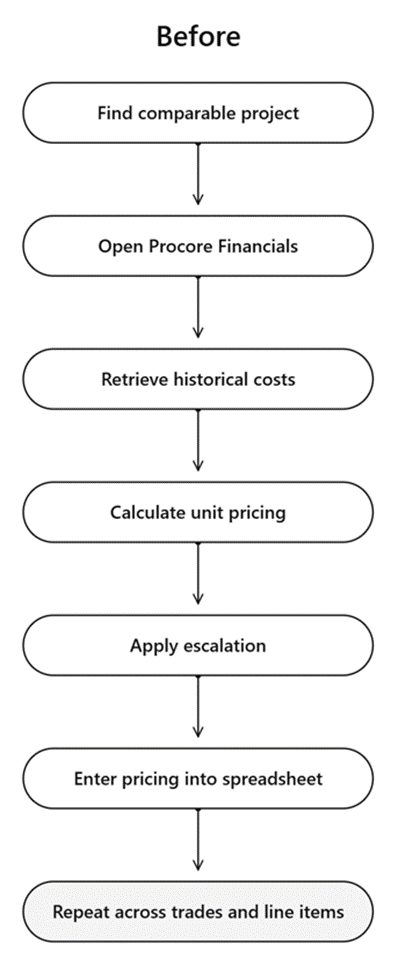
Seven manual steps stood between AMCAL’s project history and a new conceptual estimate. Historical costs had to be retrieved, normalized, escalated, transferred, and repeated across the budget.
With Zebel plus Procore Financials
The same estimating intelligence now moves through a much shorter workflow. AMCAL defines the opportunity, selects the right historical projects, and Zebel turns that information into a conceptual estimate.
How AMCAL estimates with Zebel
1. Bring project history together
AMCAL’s current project cost information lives in Procore Financials. Current cost data can be brought into Zebel’s historical cost database so completed-project information is available for future conceptual estimates.
2. Define the new opportunity
AMCAL enters roughly a dozen key project parameters, including location, site acreage, product type, unit mix, parking ratio, and other characteristics that help establish the context for the estimate⁷.
3. Select relevant comparables
The estimator determines which previous projects make sense for the new opportunity. Zebel makes those historical projects and their underlying cost information easier to access and apply without reconstructing the analysis project by project.
4. Generate and benchmark
Once the new project is defined and relevant historical projects are selected, Zebel generates the conceptual estimate. AMCAL can then compare the result with its own projects and with market data Zebel aggregates from other multifamily developers and general contractors.
Every project makes the next estimate smarter
Current project cost data becomes more valuable when it can be preserved as historical context and reused on future opportunities³ ⁴.
Each completed project adds another layer of usable cost intelligence. Instead of repeatedly reconstructing project history, AMCAL can make that experience available when the next conceptual estimate begins⁴.
Why the project parameters matter
Historical cost data is useful only when the estimator understands how the reference project relates to the proposed one. Two projects with similar total square footage can still have materially different cost profiles because of location, product type, unit mix, parking, site conditions, pricing date, and other project characteristics³ ⁷.
AMCAL’s workflow therefore does not ask only, “What did our last project cost?” It asks a more useful question: “Which previous projects provide the best cost context for this project?”
Put historical costs in a comparable context
A project’s total cost provides limited insight on its own. AMCAL’s estimating process uses relevant unit costs, such as cost per square foot or cost per unit, to create a more practical basis for comparison. The appropriate cost basis is considered alongside project characteristics and estimator judgment rather than treating every historical project as directly equivalent ⁸.
Time matters as well. Historical costs describe what something cost at a previous point in time. AMCAL’s original workflow already applied cost escalation before moving historical pricing into a new budget. Zebel accelerates the workflow, but it does not eliminate the need to interpret historical information in the context of pricing date, location, and the new opportunity² ⁶ ⁷ ⁹ ¹⁰.
What actually changed for AMCAL?
Benchmark the result
Generating the estimate is not the final step. AMCAL can instantly compare a new estimate with its other projects and with market data Zebel aggregates from other multifamily developers and general contractors⁸ ¹¹.
Why speed matters before design is complete
Conceptual estimates support decisions while a project is still evolving. A developer may be evaluating a site, comparing opportunities, testing a product mix, establishing an initial budget, or deciding whether an opportunity should continue into design¹.
At that stage, the value of faster estimating is not simply completing an estimating task sooner. It is getting cost intelligence into the development conversation while the decision is still being made.
From historical cost data to historical cost intelligence
There is a meaningful difference between having historical cost data and being able to use it. Years of completed projects have limited value if estimators must repeatedly search folders, reconstruct spreadsheets, and rebuild the same historical analysis every time a new opportunity appears³ ⁴.
For AMCAL, connecting Procore Financials with Zebel changed how quickly existing project history could become usable, estimating intelligence. The team still starts with its own experience, evaluates project characteristics, selects relevant historical projects, and interprets costs in the context of time and the new opportunity.
A practical historical cost readiness checklist
- Can you quickly find relevant past projects?
- Do you know what each historical number represents?
- Can you identify project type, location, pricing date, size, and major characteristics?
- Can you compare projects using meaningful measures such as cost per square foot or cost per unit?
- Can you account for time and escalation?
- Can you account for location and local market differences?
- Can today’s project cost information become part of tomorrow’s historical dataset?
- Can an estimator compare a new opportunity against more than one relevant historical reference point?
If the answer to several of these questions is no, the organization may not have a shortage of historical data. It may have a problem making that data reusable³ ⁶ ⁷ ⁸.
From napkins to numbers in minutes
AMCAL did not need to reinvent its estimating methodology. It needed a faster way to put years of project experience to work.
By bringing Procore Financials data into Zebel, AMCAL can turn historical costs into reusable estimating intelligence, selecting relevant comparables, generating conceptual estimates, and benchmarking new opportunities without rebuilding the analysis from scratch.
The result: work that once took days or weeks can now happen in minutes.
Sources
1. AACE International. (2020). Cost estimate classification system—as applied in engineering, procurement, and construction for the building and general construction industries (Recommended Practice No. 56R-08).
2. AACE International. (2026). Cost engineering terminology (Recommended Practice No. 10S-90).
3. U.S. Government Accountability Office. (2020). Cost estimating and assessment guide: Best practices for developing and managing program costs (GAO-20-195G).
4. U.S. Government Accountability Office. (2010). Department of Energy: Actions needed to develop high-quality cost estimates for construction and environmental cleanup projects (GAO-10-199).
5. Whole Building Design Guide. (n.d.). Cost estimating. National Institute of Building Sciences.
6. U.S. Department of Energy. (2018). Cost estimating guide (DOE G 413.3-21A).
7. Federal Highway Administration. (2026). Estimating handbook. U.S. Department of Transportation.
8. Royal Institution of Chartered Surveyors. (2024). Cost analysis and benchmarking (2nd ed.).
9. U.S. Bureau of Labor Statistics. (2026). Producer Price Index. U.S. Department of Labor.
10. Engineering News-Record. (n.d.). Construction Cost Index history: Annual average.
11. U.S. Census Bureau. (n.d.). Construction spending: Definitions. U.S. Department of Commerce.
Latest from our blog
Understanding ITBs in Construction
If you’ve ever asked, “What is an ITB in construction?”—you’re not alone. An Invitation to Bid (ITB) is a foundational document used throughout the construction industry to initiate...
Construction Work Breakdown Structure (WBS): The Complete 2025 Guide
Managing a construction project—whether it’s a residential build, commercial complex, or public infrastructure—requires meticulous planning.
Contractor’s Guide to Construction Bid Types
Understanding the various bid types is crucial for success when securing contracts in the construction industry. Navigating these bidding processes effectively can make all the difference...
Top Tips for Mitigating Cost Overruns in Construction Projects
Construction projects are known for their complexity, and even the best-planned ventures can experience cost overruns. These overruns aren’t just financial nuisances
Fast track your Precon operation upgrade
We’ve crafted a solution born from our firsthand experiences as precon professionals. Elevating it to new heights, we’re proud to unveil Zebel—an amalgamation of years of expertise and dedicated R&D, now accessible to all.


JOIN OUR Newsletter