

UrbanCore Construction: Winning with Quicker Cost Estimates

How UrbanCore transformed scattered historical cost data into a standardized estimating workflow that moves from early concepts to GMP pricing
The data existed. The workflow could not scale with demand.
As UrbanCore grew, its developer clients needed cost information faster. Historical project data existed across Excel files, but compiling information from multiple sources could take approximately a week.
In 2023, UrbanCore adopted Zebel to centralize historical data, standardize its estimating workflow, and support estimating from early concepts through detailed pricing and GMP1 2.
What once took about a week to compile can now be turned around the same day.
From scattered data to a connected estimating workflow
Before Zebel, UrbanCore’s estimating process depended on historical information stored across multiple Excel files. Estimators had to gather data from different sources, organize and interpret it, build a conceptual estimate, and then continue refining pricing as the design developed toward GMP.
With Zebel, that process became more connected. Historical project information is centralized and standardized, making relevant data easier to compare and apply. UrbanCore can develop an early conceptual estimate and continue refining it as project definition increases, moving into detailed estimating and ultimately GMP pricing.
Faster estimates are only part of the story. UrbanCore can now follow how cost expectations evolve from early historical assumptions to increasingly detailed, current pricing as the project develops.
What actually changed?
How UrbanCore uses Zebel across preconstruction
UrbanCore consolidated project information that had been distributed across Excel files. A centralized database reduced the manual gathering required before estimators could evaluate comparable work.3 4
A consistent estimating environment makes it easier to understand, compare, and reuse project information as estimating volume grows.1 5
Relevant historical data can support early cost perspectives when detailed subcontractor pricing is not yet available. UrbanCore can now support same-day estimate turnaround.6 7
UrbanCore uses Zebel from early napkin-sketch concepts through detailed estimating and GMP pricing, keeping cost development connected as project definition increases.2
From conceptual estimate to GMP: make variance useful
Conceptual estimates and GMP pricing answer different questions because the underlying information changes as a project develops. Comparing those stages helps UrbanCore identify where costs moved and investigate whether the change came from scope, quantities, market pricing, methodology, or evolving assumptions8.
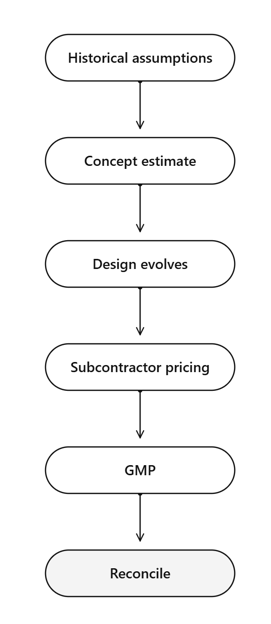
Estimate variance becomes information, not simply a new number replacing the previous one.
Why historical data still needs context
Centralization makes historical information easier to access, but it does not make every historical number appropriate for every project. Estimators still need to consider pricing date, scope, project size, location, quantities, market conditions, and how closely the reference project resembles the current opportunity3 4.
Once historical information is structured and supported by sufficient context, it becomes more useful for comparison and benchmarking8 10.
The value is not simply having more data in one place. It is being able to retrieve the right project history quickly enough to support an informed comparison.
A clearer cost story for clients
What do we expect based on history?
What changed as scope became clearer?
What does current subcontractor pricing show?
Rather than presenting each estimate as an unrelated number, UrbanCore can show how cost expectations developed as scope became clearer and current pricing became available. That continuity creates a more transparent conversation about why the estimate changed.
Every project can strengthen the next estimate
Reconciliation does more than explain the current project. Updating estimates with actual costs, project changes, and lessons learned can strengthen the historical information available for future work3 9.

Winning with quicker cost estimates
UrbanCore adopted Zebel while growth was increasing demand on its preconstruction team. Centralizing and standardizing historical information changed the speed of conceptual estimating, from approximately a week to same-day turnaround.
The larger shift is continuity. UrbanCore can carry the estimating story from early historical assumptions through detailed pricing and GMP, reconcile what changed, and preserve that learning for future work.
Quicker estimating creates immediate capacity. A connected estimating history creates a stronger foundation for the next project.
Sources
1. AACE International. (2025). 17R-97: Cost estimate classification system (August 7, 2020, editorial revision February 17, 2025). AACE International. https://web.aacei.org/docs/default-source/toc/toc_17r-97.pdf
2. AACE International. (2020). 56R-08: Cost estimate classification system—as applied in engineering, procurement, and construction for the building and general construction industries. AACE International. https://web.aacei.org/docs/default-source/toc/toc_56r-08.pdf
3. U.S. Government Accountability Office. (2020). Cost estimating and assessment guide: Best practices for developing and managing program costs (GAO-20-195G). U.S. Government Accountability Office. https://www.gao.gov/products/gao-20-195g
4. Federal Highway Administration. (1981). Technical advisory T 5080.6: Guidelines on preparing engineer’s estimate, bid reviews and evaluation. U.S. Department of Transportation. https://highways.dot.gov/laws-regulations/directives/tech-advisory/t-50806
5. ASTM International. (2024). ASTM E2516-11(2024), Standard classification for cost estimate classification system. ASTM International. https://doi.org/10.1520/E2516-11R24
6. Kim, G.-H., An, S.-H., & Kang, K.-I. (2004). Comparison of construction cost estimating models based on regression analysis, neural networks, and case-based reasoning. Building and Environment, 39(10), 1235–1242. https://doi.org/10.1016/j.buildenv.2004.02.013
7. Federal Highway Administration. (2025). Estimating handbook. U.S. Department of Transportation, Federal Lands Highway. https://highways.dot.gov/federal-lands/estimates
8. AACE International. (2020). Skills and knowledge of cost engineering (6th ed.). AACE International. https://web.aacei.org/docs/default-source/toc/toc_SK6.pdf
9. U.S. Department of Energy. (2018). Cost estimating guide (DOE G 413.3-21A). U.S. Department of Energy. https://www.energy.gov/documents/cost-estimating-guide
10. Royal Institution of Chartered Surveyors. (2024). Cost analysis and benchmarking (2nd ed.). RICS. https://www.rics.org/profession-standards/rics-standards-and-guidance/sector-standards/construction-standards/black-book/cost-analysis-and-benchmarking-2nd-edition
"What used to take us a week or more to produce a conceptual estimate has been streamlined into a matter of hours. Our repeat customers know of our new capability and it is helping them focus on viable deals, using our reliable cost data, and giving us more work opportunities."
Jon Reid
Director of Preconstruction
Latest from our blog
Understanding ITBs in Construction
If you’ve ever asked, “What is an ITB in construction?”—you’re not alone. An Invitation to Bid (ITB) is a foundational document used throughout the construction industry to initiate...
Construction Work Breakdown Structure (WBS): The Complete 2025 Guide
Managing a construction project—whether it’s a residential build, commercial complex, or public infrastructure—requires meticulous planning.
Contractor’s Guide to Construction Bid Types
Understanding the various bid types is crucial for success when securing contracts in the construction industry. Navigating these bidding processes effectively can make all the difference...
Top Tips for Mitigating Cost Overruns in Construction Projects
Construction projects are known for their complexity, and even the best-planned ventures can experience cost overruns. These overruns aren’t just financial nuisances
Fast track your Precon operation upgrade
We’ve crafted a solution born from our firsthand experiences as precon professionals. Elevating it to new heights, we’re proud to unveil Zebel—an amalgamation of years of expertise and dedicated R&D, now accessible to all.


JOIN OUR Newsletter